
Did you know that embarking on a new journey can be compared to starting a new chapter in life? It requires effort, dedication, and the willingness to learn and grow. Like a hiker starting a long trail, a person starting a new job begins at the bottom, but success in both situations is determined by taking the right steps and staying on the right path.
Only those committed to putting in the hard work and making the necessary sacrifices will be able to progress beyond the initial entry-level stage and advance to the next level. Whether it’s a new job or a challenging hike, the journey may be tough, but the rewards that come with perseverance and determination are immeasurable. So, don’t be afraid to take that first step and start your journey toward success!
Navigating the career path from entry-level to senior-level in accounting and finance can be a challenging but rewarding journey. As an entry-level professional in this field, you may begin by performing basic tasks such as data entry, account reconciliations, and financial reporting. However, as you gain experience and demonstrate your skills, you can expect to take on more complex responsibilities and move up the ranks to more senior-level positions.
Career Paths in Finance and Accounting
The field of accounting and finance offers a wide range of career paths for those interested in pursuing a career in this area.
Accounting Career Paths
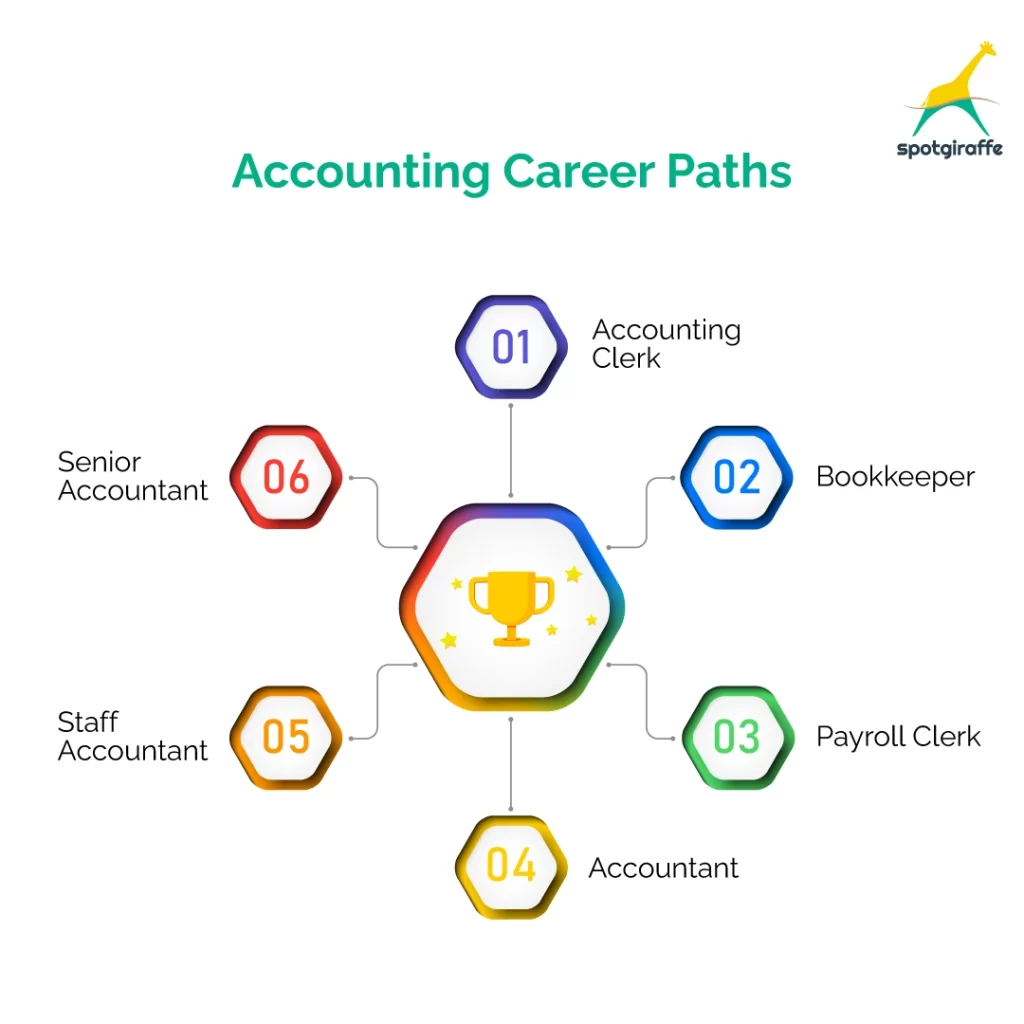
Accounting Clerk
An accounting clerk plays an important supportive role in an accounting or finance team. They assist accountants with administrative tasks such as sorting and mailing invoices, keeping records of business transactions, monitoring credit and debtor accounts and making calculations about operational costs. This role offers a great opportunity to gain valuable experience and learn how businesses operate. Strong attention to detail and good organizational skills are also important in this role. As you gain experience, there may be opportunities for advancement within the accounting or finance team, such as becoming an accountant or financial analyst.
Bookkeeper
Bookkeepers’ major work is helping business owners or managers make informed financial decisions and keep track of their business activities. Their responsibilities include processing and recording financial transactions and cash flow, managing payroll systems, producing financial documents such as income statements and balance sheets, reconciling financial records against bank statements, and ensuring compliance with organizational tax requirements.
Payroll Clerk
Payroll clerks work to ensure that an organization’s employees are paid accurately and on time. Their work typically involves preparing payrolls and related records, such as timesheets and tax forms, to meet statutory requirements and employee expectations.
Accountant
Accountants play a crucial role in analyzing, interpreting, and reporting financial matters for organizations or individuals. They help people understand their own or their organization’s financial position and make informed decisions based on that information.
There are several different accounting specializations, including tax, financial, management, and forensic accounting. Tax accountants are experts in complex tax laws and procedures, and they help individuals and businesses minimize their tax burden while remaining compliant with regulations. Financial accountants examine a business’s performance for external clients, such as investors or lenders, to optimize decisions about whether to invest in a business, provide a loan, or undertake regulatory action.
Management accountants work within a business to report financial information to executive and board members. Their reports are used to optimize business performance and maximize profits. Forensic accountants prevent and investigate financial crimes such as fraud, tax evasion, and money laundering. They do this by analyzing individual and business financial information such as bank statements, spreadsheets, and reports.
Staff Accountant
As a Staff Accountant in an entry-level role, you will work preparing and maintaining financial and business transactions while applying accounting principles. Your duties will involve analytical, evaluative, and advisory work that requires a deep understanding of accounting theory and practice.
Senior Accountant
After gaining four to six years of experience as an Accountant, you can advance to the position of Senior Accountant. In this role, you will continue to prepare and maintain financial records, but you will also be responsible for leading and directing the work of others. If you haven’t already obtained one, pursuing a bachelor’s degree in commerce is highly recommended at this point in your career. This degree will give you the advanced knowledge and skills necessary to excel in your field and take on more complex accounting tasks.
Finance Career Paths
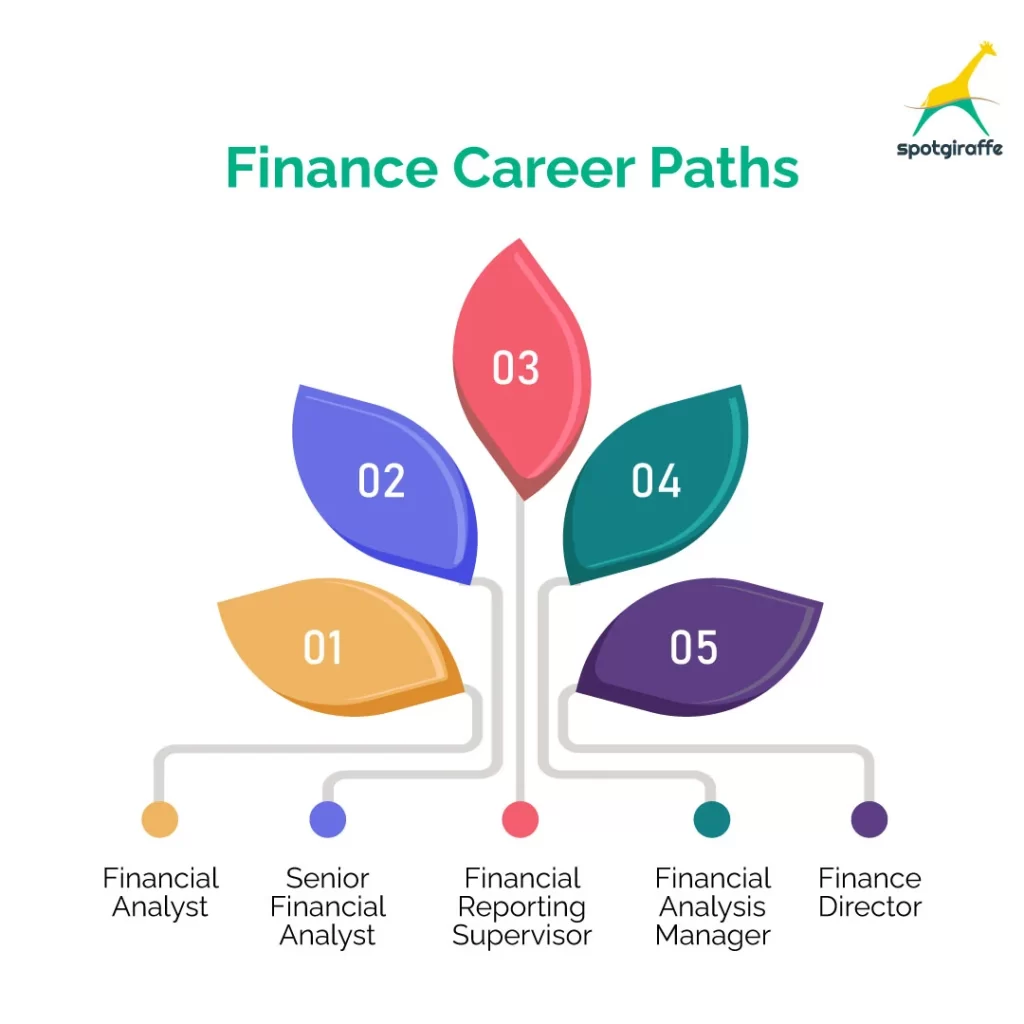
Financial Analyst
To qualify for this entry-level role as a Financial Analyst, you will need to hold a bachelor’s degree. Financial Analysts will be responsible for analyzing past and present financial data to estimate future revenues and expenditures by applying finance principles.
The duties will involve various tasks such as collecting and analyzing financial data, creating financial models, and preparing reports to aid decision-making. Financial analysts must be skilled in identifying trends, conducting variance analyses, and evaluating financial performance.
Senior Financial Analyst
Senior Financial Analysts will be vital to the success of the organization, and you will be expected to have a deep understanding of financial principles and concepts. With dedication and hard work, the Senior Financial Analyst role can lead to even more senior positions in finance, such as Finance Manager or Director of Finance. This position offers a great opportunity to further develop your financial analysis skills and advance your career in finance.
Financial Reporting Supervisor
After gaining experience as a Senior Financial Analyst, you may advance to the role of Financial Reporting Supervisor. The Financial Reporting Supervisor needs to take care of managing all Securities and Exchange Commission external reporting requirements, including the preparation and filing of Forms, Proxy Statement, and other periodic governmental reports.
Financial Analysis Manager
Finance Analysis Manager should need to manage the conduct of statistical analyses of information affecting financial and accounting programs of public, industrial, and financial organizations through subordinate financial analysis staff.
Finance Director
The Finance Director’s work is directing and overseeing financial analysis, evaluation, and report generation of current and proposed financial plans, developing financial forecasts and budgets, analyzing financial data, and identifying trends and opportunities for improvement.
Regardless of the specific path chosen within the career path in finance and accounting, setting clear short- and long-term career goals is essential. This allows individuals to identify the necessary steps needed to achieve their career objectives. To find multiple career opportunities in the finance and accounting sector, look for the website SpotGiraffe which is specially designed for job seekers who are trying to get job opportunities in the accounting and finance industry. By using this website, one can find the best jobs in the industry based on their preference. Our career platform also offers professional skills development, leading to better career opportunities in the job market.